
How to Check Face-Paint Labels Before Building a Convention Makeup Look
A successful costume makeup plan starts before the first brush touches skin. The shade, finish and lighting effect matter, but so do the intended body area, removal instructions and identity of the product. A bright pigment that looks right on a prop may be unsuitable for the face. Organizing that information early makes a convention morning easier and prevents artistic decisions from becoming improvised product decisions.
Begin with the intended use
Look for a product intended for cosmetic use in the location where you plan to apply it. Craft paint, printing pigment and decorative glitter should not be treated as face makeup simply because the colour matches a character. Similar appearance does not establish similar composition, particle properties or permitted use.
FDA guidance on novelty makeup explains why theatrical and costume products still need attention to ingredients and directions. The useful starting question is specific: is this product intended for this part of the body? It is more informative than asking whether a pigment is generally described as safe somewhere on a seller’s page.
Keep eye-area decisions separate
A colour permitted in one cosmetic application may not be permitted near the eyes. The product’s name, a photograph of a dramatic look or a vague face-and-body description should not substitute for the relevant instructions. Read the packaging, including warnings printed on the outer box that might otherwise be thrown away.
The FDA’s colour-additive tables separate eye-area, general and external uses and include limitations. These tables concern United States rules; products elsewhere are subject to their local requirements. If you cannot establish the intended use, choose a clearly labelled alternative rather than testing the uncertainty during an event.
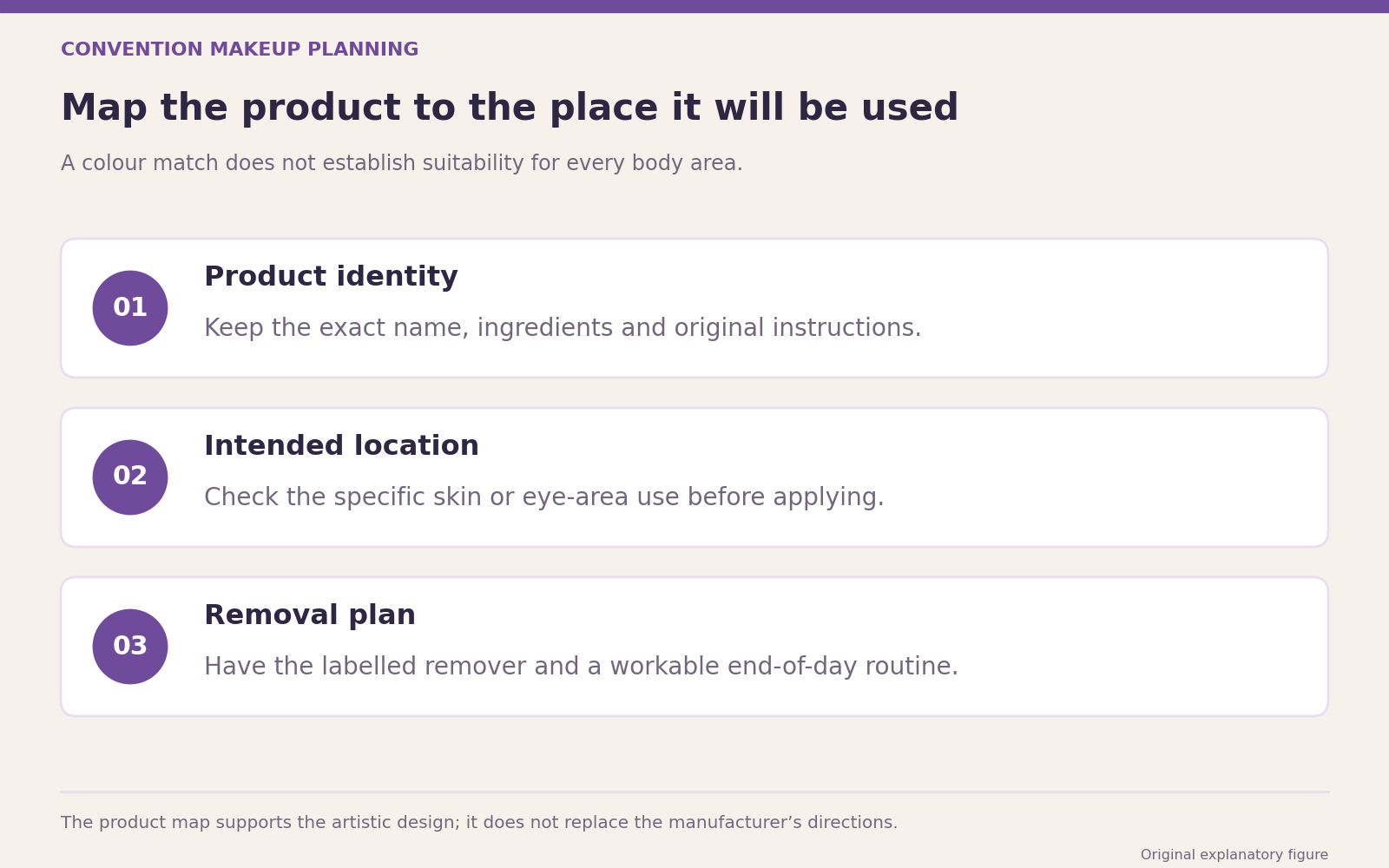
Make a product map before a face chart
Draw the intended look and give each region a product name. Record the exact item rather than writing only blue, glitter or liner. Add its intended location and removal method. The result is a product map: an artistic design tied to the actual materials that will create it.
| Design area | Record before application |
|---|---|
| Large colour field | Exact cosmetic product and labelled use |
| Detail near the eye | Explicit eye-area suitability and warnings |
| Decorative effect | Whether the material is intended for skin |
| Removal | The manufacturer’s method and required supplies |
This map also helps when someone else assists. A friend can identify the correct product without selecting a visually similar craft supply from a crowded table. Keep original labels available even if a small amount is placed in a working palette.
Try the complete routine in advance
Follow the manufacturer’s directions for any preliminary skin check and stop using a product if it causes irritation. A small preliminary application cannot guarantee that a later reaction will never occur, and it is not the same as diagnostic allergy testing. Its practical value is checking the intended routine before a long day away from home.
Rehearse removal as well as application. A design that takes two hours to paint may take significant time and suitable supplies to remove. Do not assume that scrubbing harder is the answer if the chosen remover does not work. Knowing the labelled method beforehand makes it easier to plan a comfortable end to the day.
Plan for changes during the event
A makeup look is exposed to movement, perspiration and contact with costume pieces. Record which components rub against the skin and which areas you may need to leave clear. A collar or mask edge that repeatedly contacts a painted area can create a practical problem even when the colour looks perfect in a photograph.
Carry the supplies needed for the specific products in use, including their instructions. Keep a clean way to handle touch-ups, and avoid treating a crowded public surface as a clean palette. If someone else borrows a product, do not lose track of how applicators are being shared. The artistic plan should include handling, not just pigment selection.
Do not judge a reaction by colour alone
A dense layer of makeup can make changes in the underlying skin harder to see. Pay attention to discomfort as well as appearance, and remove a product according to its directions if a problem develops. Persistent or significant symptoms deserve appropriate professional advice. A convention photograph is not a reliable way to diagnose the cause.
Likewise, a product described as natural or hypoallergenic does not provide an individual guarantee. Those words do not tell you everything about the formulation or your response to it. Keep the ingredient information and product identity so that a question can be investigated without relying on memory of a shade name.
Separate temporary colour from biological pigment
Face paint places coloured material on the surface. The skin’s own colour involves cells and pigments produced within tissue. These processes differ in location, timescale and mechanism. Removing a cosmetic layer is not the same thing as changing the pathways through which melanocytes produce melanin.
That distinction is useful when artistic descriptions borrow biological words. A product can imitate the appearance of a character without reproducing a biological process. A dramatic visual effect does not require claims about hormones, cell regeneration or changing the body itself. Keeping the aim visual makes the product decision much clearer.
When a plan changes, update the product map rather than assuming a replacement behaves like the original. Two products described as metallic silver may use different ingredients and require different handling. A substitution is a new material decision, even when the finished photograph looks almost identical.
Leave a short record for the next event
After the rehearsal or convention, note what was easy to apply, which areas rubbed, how removal went and whether any product caused a problem. Add photographs of the labels to your private planning notes if that is convenient. Preserve the information for the exact products used rather than assuming every item sold under a similar colour name is equivalent.
A useful makeup plan can fit on one page: design, product identity, intended location, handling and removal. That page supports the creative work instead of competing with it. It also provides a natural starting point for learning how skin itself produces colour, responds to heat and communicates through molecular signals.